Who is liable for a slip and fall in Queens depends on where it happened. On a sidewalk, it is usually the adjoining property owner, under section 7-210 of the city’s Administrative Code. The City can be liable in front of an owner-occupied one- to three-family home and next to City property.
Inside a store, lobby or apartment building, the business or landlord is usually responsible. The directory below lists ten firms that take slip, trip and fall cases, starting with the eight that have an office in the borough. After it come the sidewalk rules in detail, the snow-clearing deadlines and the 90-day notice of claim against the City.
Slip and fall law firms serving Queens
Firms with an office in Queens come first, then firms that serve Queens from elsewhere in New York City, each group in alphabetical order. A listing is not a recommendation, and we have not checked the quality of any firm’s work. Offices and phone numbers are taken from each firm’s website in November 2026.
Cohen & Cohen Personal Injury Lawyers, P.C. (Queens)
Office: Forest Hills
(718) 275-7779
cohenandcohenlawgroup.com
Davidoff Law (Queens)
Office: Fresh Meadows
(718) 268-8800
lawfirmdavidoff.com
Elliot Ifraimoff & Associates, P.C. (Queens)
Office: Forest Hills
(718) 205-1010
888askelliot.com
Law Offices of Michael Dreishpoon (Queens)
Office: Forest Hills
(718) 793-5555
dreishpoon.com
Oresky & Associates, PLLC (Queens)
Office: Jackson Heights
(718) 577-2490
oreskylaw.com
Parker Waichman LLP (Queens)
Office: Forest Hills
(718) 469-6900
yourlawyer.com
The Perecman Firm (Queens)
Office: Corona
(718) 587-0108
perecman.com
Shaevitz & Shaevitz (Queens)
Office: Jamaica
(718) 291-3400
shaevitzandshaevitz.com
Finz & Finz, P.C. (New York)
Offices: Manhattan, Brooklyn
(212) 513-1000
finzfirm.com
Law Offices of Jay S. Knispel (New York)
Offices: Manhattan, Brooklyn
(212) 564-2800
jknylaw.com
Want to boost your visibility as a lawyer in our directory? Ask for our promotion packages at info@queens.today.
Half of the Queens offices are on or near Queens Boulevard in Forest Hills. Most of these firms handle every kind of personal injury case in Queens, and a fall from a scaffold or ladder at work is usually a construction accident case instead. For other practice areas, see our directory of lawyers in Queens.
Who is responsible for a fall on a Queens sidewalk
In New York City, the sidewalk in front of a building is mostly the property owner’s job, not the City’s. The New York City Department of Transportation (NYC DOT), which looks after the city’s streets, says owners must install, repair and maintain the sidewalk next to their property under section 19-152 of the city’s Administrative Code.
Section 7-210 of the same code makes owners liable for injuries caused by their failure to keep that sidewalk reasonably safe, including negligently failing to repair broken flags (the concrete squares of the sidewalk) or to remove snow and ice. NYC DOT lists common defects such as collapsed sidewalk, trip hazards, an improper slope, patchwork and hardware that sticks up.
There is one big exception. Section 7-210 does not apply to one-, two- or three-family houses that are at least partly lived in by the owner and used only as homes. For sidewalks in front of those houses, the City rather than the owner can be liable, so the City’s claim rules below apply.
Inside a store, a lobby or an apartment building, the owner or the business that runs the space is usually responsible for keeping it safe. NYC DOT expects utilities and contractors to repair sidewalk damage they cause, so they may also share responsibility. Report a broken sidewalk to NYC 311, the City’s information and complaints line.
Snow and ice: the clearing deadlines
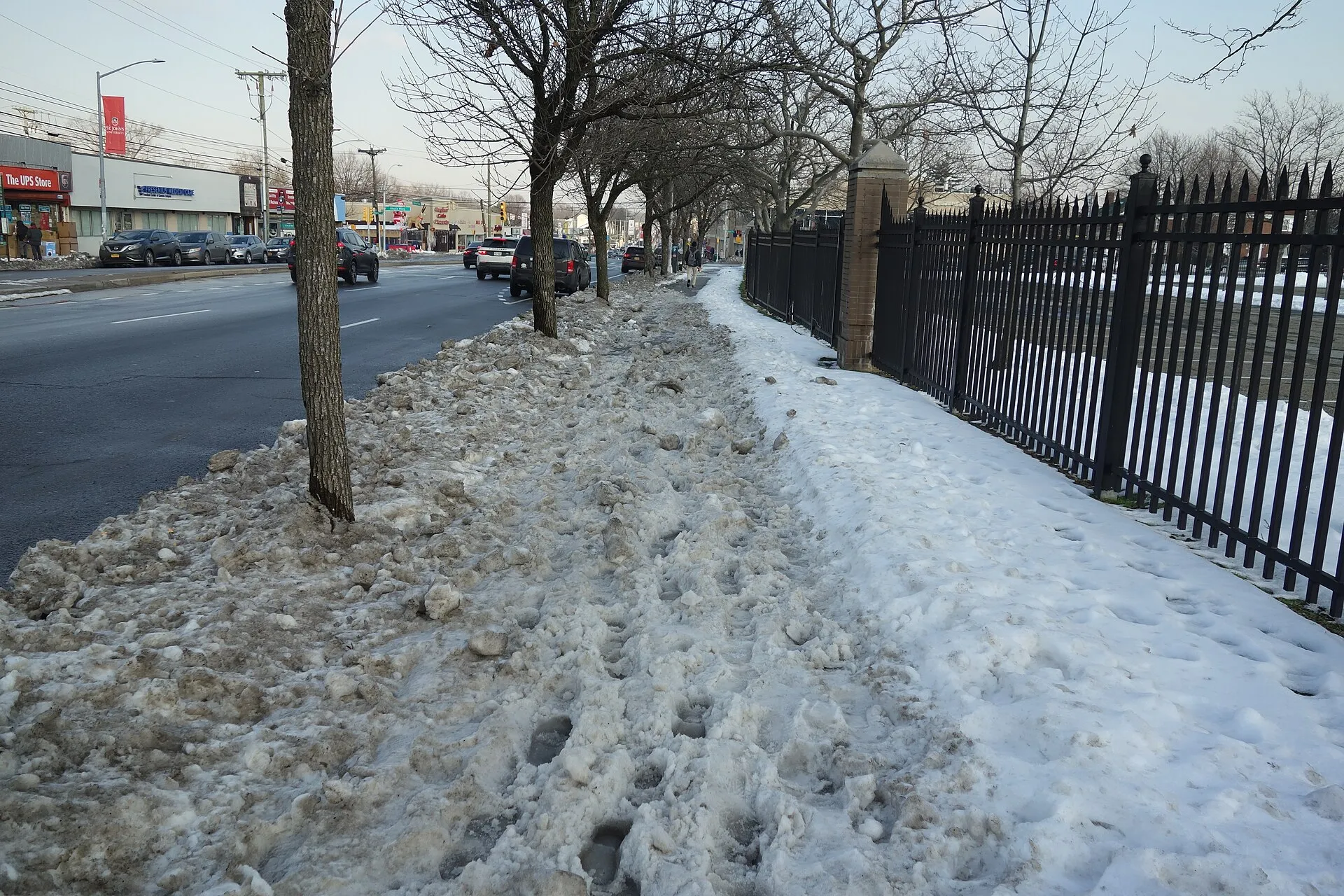
The Department of Sanitation (DSNY), the City agency in charge of snow removal, says building owners and occupants must clear a path at least four feet wide on the sidewalk in front of their building. They must also clear the snow and ice around fire hydrants and at the curb ramps next to the building.
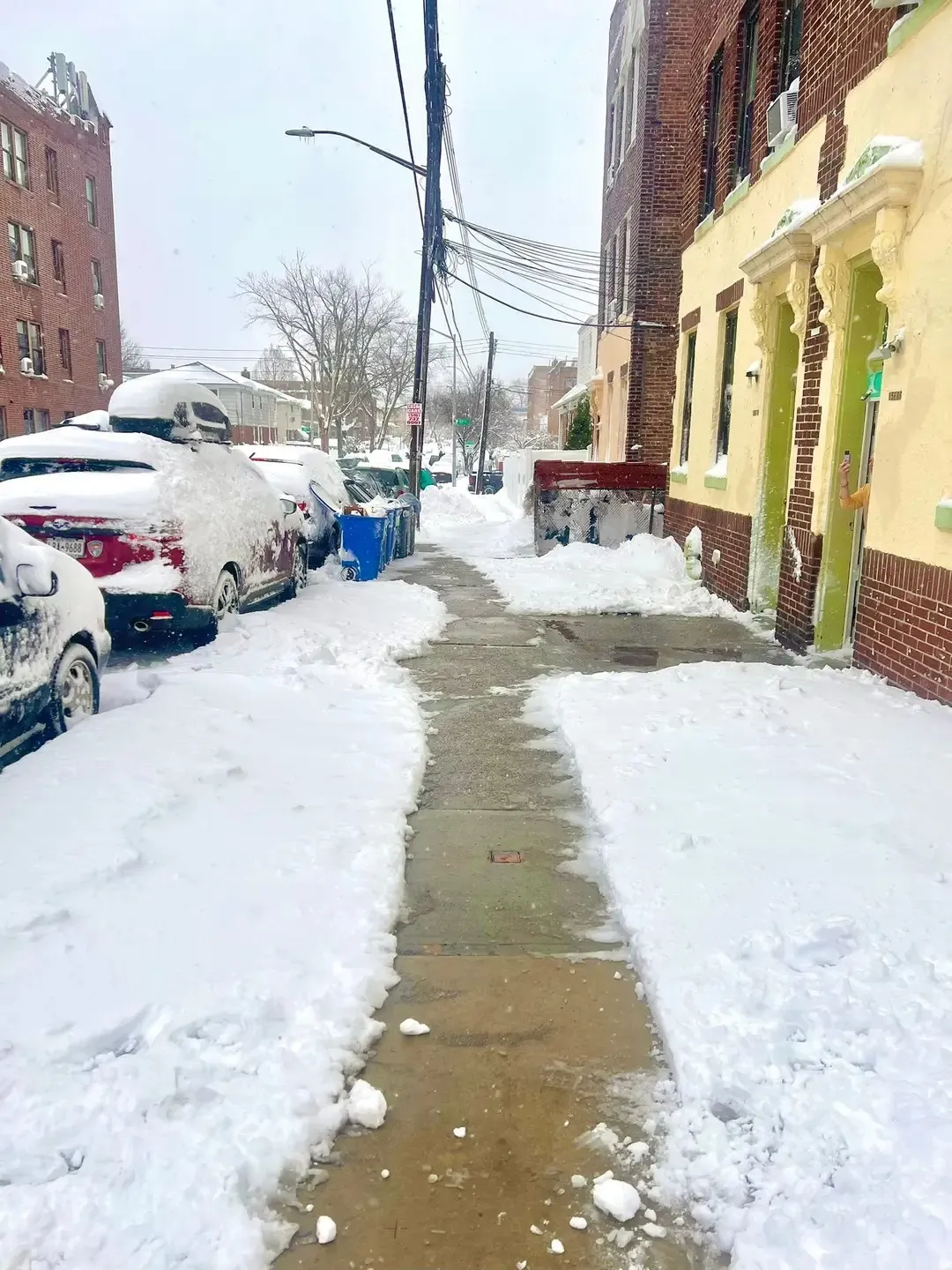
The deadline depends on when the snow stops. If it stops between 7:00 a.m. and 4:59 p.m., the path must be clear within 4 hours. If it stops between 5:00 p.m. and 8:59 p.m., the owner has 14 hours. If it stops between 9:00 p.m. and 6:59 a.m., the sidewalk must be clear by 11:00 a.m.
If ice is frozen too hard to remove, owners can spread salt or sand on it. DSNY enforces the rules with fines of $100 for a first offense, $150 for a second and $250 after that. Whether an owner missed a deadline may be relevant to an injury claim, so note when you fell and when the snow stopped.
Claims against the City: the 90-day notice of claim
Stricter rules apply if the City of New York is responsible for the spot. That covers streets, City buildings and sidewalks in front of City property or an owner-occupied one- to three-family house. The Office of the New York City Comptroller handles these claims, and you must file a written notice of claim there before you can sue the City.
For injuries, the notice must be served within 90 days of the fall under section 50-e of the state’s General Municipal Law. You can file online through the Comptroller’s eClaim system, deliver it in person, or send it by registered or certified mail. Ninety days pass quickly while you recover from an injury.
Falls involving the subway, buses, public housing or City hospitals work differently, the Comptroller says. Claims against the MTA, New York City Transit, NYCHA, NYC Health + Hospitals and other authorities must be served on that authority, not on the Comptroller. A fall caused by a defect on a New York State highway needs a separate claim with the State.
Why the City’s prior written notice rule matters
Even with a timely claim, a case against the City over a broken sidewalk or street can fail. Section 7-201(c)(2) of the Administrative Code, quoted by the Comptroller, says no lawsuit can go ahead for such a defect unless the City had written notice of it and did not fix it within 15 days.
The law also allows a few alternatives to that written notice, for example a written acknowledgment of the defect by the City. Finding out whether the City had notice takes time, which is one reason many people hire a lawyer early in a claim against the City.
What to do after a slip and fall in Queens
Get medical care first, and tell the doctor how you fell. Then take photos of the exact spot from several angles, ideally with something in the frame that shows the size of the crack, step or patch of ice. Conditions change fast: ice melts, spills are mopped up and broken sidewalks get repaired.
Write down the address or the nearest building number, the time, the weather, and the names and phone numbers of anyone who saw the fall. If you fell in a store or a building, ask staff to make an incident report and keep a copy. Keep your shoes, medical records and receipts.
How to choose a slip and fall lawyer
Ask how many sidewalk, stair and premises cases the firm has handled, and whether it takes cases against the City of New York. A firm that knows the notice of claim process and Queens property records can act quickly in the first weeks.
Most injury firms work on a contingency fee: they take a share of the money recovered and nothing if the case is lost. Ask what percentage they take and who pays costs such as medical records and expert reports if the case does not succeed. Ask, too, who will handle your file day to day.
Use the free first consultation that most firms offer. Bring your photos, medical records, the names of witnesses and any letters from an insurer or from the City. If you were hurt as a pedestrian by a vehicle rather than by a fall, our Queens car accident lawyer directory is the better place to start.
Not legal advice: This page is general information, not legal advice. A listing in our directory is not an endorsement, and we do not verify the credentials of the lawyers listed. No attorney-client relationship is created by using this site. Deadlines and rules change; for advice about your own fall, contact a qualified lawyer.
Sources
- Sidewalks, New York City Department of Transportation
- Snow and Ice Removal Laws, New York City Department of Sanitation
- § 7-210 Liability of real property owner for failure to maintain sidewalk in a reasonably safe condition, New York City Administrative Code (unofficial online edition)
- File a Claim, Office of the New York City Comptroller
Image sources
- Trampled snow and slush covering the sidewalk along Union Turnpike at 176th Street in Fresh Meadows, Queens: Tdorante10, CC BY-SA 4.0 · Wikimedia Commons · Licence
- A shoveled path through deep snow on a residential sidewalk in Flushing, Queens: Kidfly182, CC BY 4.0 · Wikimedia Commons · Licence